What to Expect on a Corporate Video Shoot Day (From Setup to Final Delivery)

For most business owners, a professional video shoot is not something they do every year. When it is your first time, or even your second, there is a lot of uncertainty heading into it. What time does the crew arrive? Do I need to have a script memorized? How long is this actually going to take? What happens after the shoot?
That uncertainty is completely normal and it is also completely avoidable. A good production company walks you through every stage before the camera ever turns on. This post does the same thing.
Here is exactly what the process looks like from the week before your shoot through the day you receive your finished video.
The Week Before Your Shoot
Pre-production is where the shoot actually starts
A lot of clients think of shoot day as the beginning of the project. It is not. By the time the crew arrives at your location, the most important decisions have already been made.
In the week leading up to your shoot, you and your production team should have finalized several things. You will have gone over the concept or script together and confirmed the key messages you want the video to communicate. You will have walked through or discussed the filming location so there are no surprises about space, lighting, or background. You will know who is appearing on camera and what they will say or do. And you will have a clear shot list, meaning a written plan of every scene the crew intends to capture.
All of that planning is what allows a shoot day to move efficiently instead of everyone standing around figuring things out on the fly.
What you can do to prepare:
• Confirm your location is clean, organized, and ready to be on camera
• Brief any staff or team members who will appear on screen
• Review any talking points or key messages so they feel natural, not memorized
• Plan your wardrobe: solid colors photograph better than busy patterns, and avoid pure white or bright red
• Make sure the filming area has minimal background noise and foot traffic during scheduled shoot times
You do not need to be a natural on camera. That is what the production team is there to help with. The goal of pre-production prep is to make sure the logistics are handled so shoot day can focus on getting great footage.
Shoot Day: Arrival and Setup
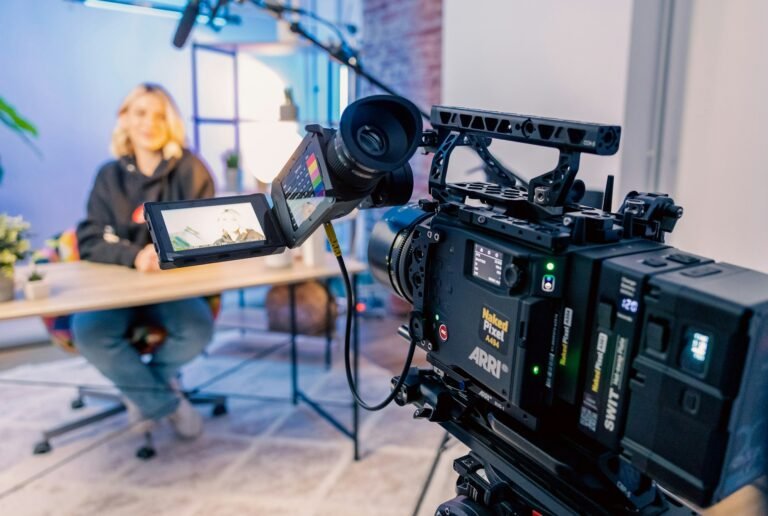
The crew typically arrives 30 to 60 minutes before filming begins. This time is used for setup and is not wasted time on your end. It is where a lot of the technical groundwork gets laid.
What setup looks like:
• Camera and audio equipment is brought in and assembled
• Lighting is placed and adjusted based on the space and the look of the shot
• The background and frame are reviewed to make sure nothing distracting is in the shot
• Microphones are tested and adjusted for the space and the speaker
• The production team does a quick walkthrough to confirm the shot list and sequence for the day
You do not need to be involved in every part of setup. The best thing to do during this time is stay accessible and let the crew work. If there are last minute questions, they will come to you.
During Filming: What Actually Happens
Once setup is complete, filming follows the shot list. The sequence may not match the final order of the video. Corporate videos are rarely filmed start to finish. Interviews might be filmed first, then b-roll footage of your space and team, then any product or service demonstrations. The editor assembles everything in order during post-production.
Interviews and on-camera speaking
If you or someone from your team is speaking on camera, here is what to expect. You will not be memorizing a script word for word. You will be talking about your business naturally, guided by a few key points or questions. The production team will prompt you, let you take your time, and do multiple takes if needed. Nobody expects perfection on the first try. The goal is to capture something that sounds genuine, not rehearsed.
Most people are more comfortable on camera than they expect once the camera is actually rolling. The nerves before the take are almost always worse than the take itself.
B-roll footage
B-roll is the supporting footage that runs while someone is speaking or between interview segments. It might be shots of your team working, your facility, your products or services in action, or exterior footage of your building. B-roll is what gives a video visual depth and keeps it from being a talking head the entire way through.
During b-roll filming, you and your team are working naturally. The crew captures what they need around you. You do not need to perform for the camera during this portion. Just do what you normally do.
How long does a shoot day take?
Most corporate video shoots run between two and six hours depending on the scope of the project. A single testimonial or brand overview video might take two to three hours including setup. A larger project with multiple interview subjects, multiple locations, and extensive b-roll will take longer. Your production team will give you a realistic time estimate before the shoot day so you can plan accordingly.
After the Shoot: Post-Production
The shoot is finished. Now the production team takes everything they captured and turns it into your finished video. This is post-production and it is where the real craft of the project happens.
STEP 1 Footage Review and Logging
The editor reviews all footage from the shoot and identifies the best takes, the strongest b-roll moments, and any audio issues that need to be addressed. For a typical corporate video, the crew captures far more footage than ends up in the final cut. The selection process is where the story starts to take shape.
STEP 2 Assembly Cut
The editor assembles a rough version of the video in the correct order. This is not the polished final product. It is a working draft that shows the structure and pacing. Music is often added at this stage to help the edit feel complete, even if it is placeholder.
STEP 3 First Edit Delivered to You
You receive a link to review the first edit, typically within five to ten business days of the shoot depending on the project scope. You watch it, take notes, and share your feedback. Good production companies give you a clear format for feedback so the revision process is efficient and does not go in circles.
STEP 4 Revisions
Revisions are made based on your feedback. Most projects include one to two rounds of revisions in the agreed scope. A round of revisions is your chance to request changes to pacing, wording, music, or specific sections. Major structural changes or entirely new footage are handled separately.
STEP 5 Color Correction and Audio Finishing
Once the edit is approved, the video goes through color correction so it looks visually consistent throughout, and audio finishing so the levels, tone, and clarity are polished. This is the stage that takes a good edit and makes it feel professional.
STEP 6 Final Delivery
You receive the finished file in your preferred format. Most corporate videos are delivered as an MP4 in HD or 4K resolution. You also receive any additional export formats you need for web, social media, or broadcast use. At Next Level Visions, you own the final video outright with full commercial usage rights.
Frequently Asked Questions
Do I need a script or will the production team write one for me?
It depends on the project and your preference. Some clients come in with a script already written. Others prefer to talk through key points naturally on camera and let the editor shape the narrative in post-production. For scripted corporate videos and commercials, scripting is part of the pre-production process and is handled collaboratively with your production team. For testimonial or interview-style videos, a script is usually not necessary.
What if something goes wrong on shoot day?
Things occasionally do not go as planned. A team member is sick, a location has unexpected noise, lighting conditions change. A professional production team handles these situations as a matter of course. Most issues can be adjusted on the fly without affecting the final product. If something significant needs to be reshoot, your production agreement should outline how that is handled.
How many people will be on the crew?
For most small to mid-size corporate video projects, the crew is one to three people. For larger productions with multiple camera setups, audio needs, or lighting requirements, the crew may be larger. At Next Level Visions, most corporate and small business projects are handled as a solo or two-person production, which keeps things efficient and minimally disruptive to your normal business day.
Can I be involved in the editing process?
Yes, within the revision structure. You will review the first edit and provide feedback. Some clients want to be closely involved in every decision. Others prefer to review once and approve. Both approaches work. The key is that the revision process is structured and documented so the project stays on schedule and within scope.
What file formats will I receive?
Standard delivery is an MP4 in HD (1080p) or 4K resolution. If you need additional formats for social media (vertical 9:16 for Reels or TikTok, square 1:1 for Instagram), broadcast specifications, or email embedding, those can be discussed during pre-production and included in your project scope.
Ready to Schedule Your Corporate Video Shoot in Maryland?
Now that you know exactly what the process looks like, the next step is a simple conversation to find out whether the project is the right fit and what it would involve specifically for your business.
We work with businesses throughout Hagerstown, Frederick, Gaithersburg, and the broader Maryland region. Contact us here to schedule a free 15-minute call. We will walk through your goals, your timeline, and give you a clear picture of what your project would look like from shoot day through final delivery.
If you are still in the research stage, our corporate video production page covers the types of projects we handle and our approach in more detail. You can also review video production pricing to get a realistic sense of investment ranges before we talk.
About the Author: Craig Kilgore is the founder of Next Level Visions, a video production company based in Hagerstown, Maryland. He has produced corporate videos, commercials, testimonials, and documentary content for businesses and organizations throughout the DMV region. His documentary film I Was the Weirdo won Best Documentary at the New York Hip Hop Film Festival.